



 All services

Check that a lawn is allowed first
Before anyone orders a pallet, the question is whether the yard may have grass at all. The rules differ by city and by the age of the house, as of November 2026.
- Henderson. A home permitted on or after September 19, 2022 may have no lawn grass. On older homes, grass in the back and side yards can cover up to 50 percent of that yard area (or 100 square feet, whichever is greater), with no strip narrower than 10 feet, on a slope under 25 percent, graded so it doesn't run off. Total grass on the lot tops out at 2,500 square feet if you had less than that before September 2022; if you already had more, you can't add any. A front-yard lawn survives only where grass was in place by the end of 2003, and dead grass has to be replaced within a year or the right to it ends. The code allows no variances.
- Las Vegas Valley Water District customers (Las Vegas and parts of unincorporated Clark County). The district will not serve water used on grass at properties that received their certificate of occupancy after April 5, 2022.
- North Las Vegas. No one may install new grass in the front, side or back yard of a single-family home. Back and side-yard grass that was there before October 10, 2022 is grandfathered.
The state ban on nonfunctional grass that starts January 1, 2027 doesn't apply to property used only as a single-family home. These rules cover the Las Vegas Valley water systems. In Pahrump, check with Nye County and your water provider before planning a lawn.
Pick a grass that suits the heat
University of Nevada, Reno Extension calls turf-type tall fescue the most popular lawn grass in the Mojave Desert, though it is among the thirstiest. Warm-season grasses use less water as a group, and SNWA says bermuda needs about a third less. Common bermudagrass sheds heavy pollen, and Extension notes that Clark County ordinances prohibit planting it, so a warm-season lawn here should be a hybrid bermuda, which produces less pollen. Bermuda goes dormant in winter and needs little water then. St. Augustine has the best shade tolerance of the warm-season grasses; Kentucky bluegrass struggles in the heat unless mixed with others.
The shape of the lawn matters too. Extension advises against sprinkler-watered grass on slopes steeper than 3:1 or in strips narrower than 8 feet, because sprinkler coverage there is uneven and the water runs off.
Lay it in the right months
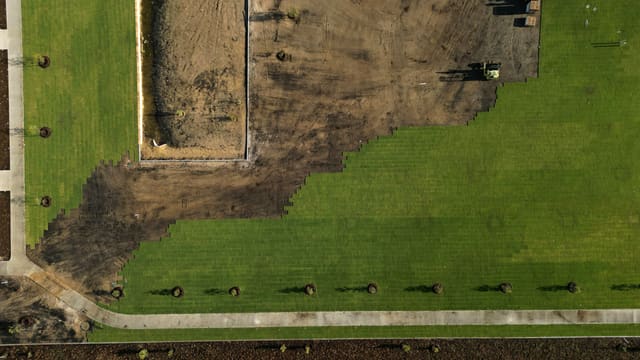
Warm-season grass goes in from April through June from seed or sprigs, and sod stretches that window to the start of August. Cool-season fescue does best laid from February through March or mid-September to mid-October. Extension says to avoid June through August and December through January for cool-season sod. In summer, sod goes down in the early morning while the soil is cool, and gets water right away.
Prepare the ground before the rolls arrive
Extension's recipe is 2 to 3 inches of compost worked 10 to 12 inches deep, then the soil firmed until a footprint sinks no more than half an inch. Caliche, the lime-cemented layer common in valley soils, blocks drainage and has to be broken or removed so water can get through.
What changes the job:
- What's there now. Stripping a dead lawn, rock or weeds takes longer than tilling bare dirt.
- Caliche and grade. Breaking hardpan and regrading for runoff add digging.
- Sprinklers. Heads may need moving or replacing so water reaches the edges without hitting walls and sidewalk.
- Access. A pallet covers about 500 square feet and weighs around 1,800 pounds, so a narrow side gate means carrying rolls in.
We call 811 before any trench or tilling, as Nevada law requires, and we'll need you to show us the valves, the clock and any lines you own past the meter, such as gas to a barbecue.
Water it in without a fine
New sod needs water several times a day while it roots, which the normal schedule doesn't allow. Each water provider handles that its own way. The Las Vegas Valley Water District lets you water new or reseeded landscape daily for up to 14 days, once per calendar year, if you call before planting. Henderson takes requests for 30 days once a year, and its 11 a.m. to 7 p.m. summer ban still applies. North Las Vegas allows 30 days with notice. Ask before the sod arrives.
After that, SNWA's cycle-and-soak advice takes over: three runs of no more than 4 minutes each, 1 to 2 hours apart, or 12 minutes a run for rotor heads, stopping before water runs off. Water that sprays or flows off your property counts as water waste. We handle the demo, soil, sod and sprinkler adjustments as one contractor, and the estimate is free.
Sources
- Chapter 14.14 Conservation Henderson Municipal Code (Ord. 3905, 2022).
- Watering schedule City of Henderson.
- Service Rules, Chapter 3 and mandatory watering schedule Las Vegas Valley Water District.
- Chapter 13.08 Water Conservation North Las Vegas Municipal Code (Ord. 3147, 2022).
- AB 220 (2023) Nevada Legislature.
- Turfgrasses for urban Mojave Desert landscapes University of Nevada, Reno Extension, FS-11-52.
- Lawn establishment in the Mojave Desert University of Nevada, Reno Extension, FS-11-54.
- Becoming a desert gardener University of Nevada Cooperative Extension, SP-01-15.
- How and when to water, watering tips and water waste Southern Nevada Water Authority.
- NRS Chapter 455: underground facilities Nevada Legislature (2025 revision).
- Homeowner guide to safe digging Public Utilities Commission of Nevada.


