
 All services

Start with the soil
Clay, sand and rock-hard caliche make up most of the soil in the Las Vegas Valley, according to the Southern Nevada Water Authority. Caliche is soil cemented together by lime. UNR Extension describes it as a layer anywhere from a few inches to several feet thick that acts like a hardpan and blocks drainage. Nevada soils also run alkaline, with a pH of 8.0 or higher.
A planting hole that can't drain holds water around the roots. Extension's test: dig a hole 2 feet on each side and 2 feet deep, fill it with water, and if water still stands after six hours, the drainage is poor. Where caliche is the problem, Extension says to break or remove it so water can get through, and for flower beds on very poor soil, to dig out 6 to 12 inches and replace it with soil that has organic matter in it. SNWA adds that compost improves the texture of caliche-based soil.
Pick plants that belong here
The Southern Nevada Regional Plant List (updated June 2026) is the list SNWA uses for its rebates and the list Clark County points to for new development. Trees get 1 to 5 stars, and trees rated 3 stars and above are the recommended ones, adapted to desert heat and seasonal drought. Shrubs marked "bulletproof" are the ones the list rates "extremely drought tolerant," cold hardy, and pest and disease resistant once established; Henderson's code uses the same tag for drought-tolerant plants.
On the list you'll find:
- Trees: blue palo verde, foothill palo verde, Texas honey mesquite and desert willow.
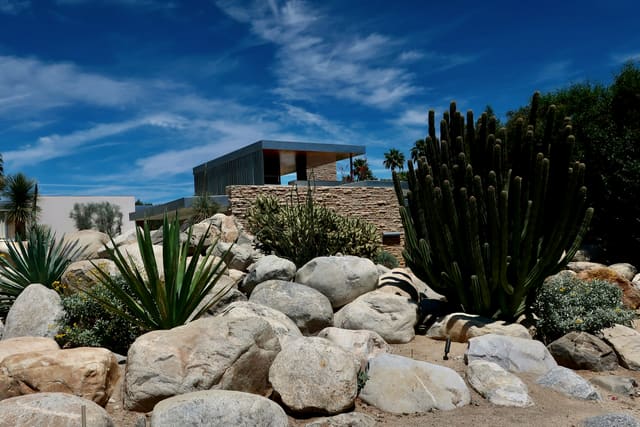
- Accents: century plant (Agave americana), desert spoon and red yucca.
- Shrubs and groundcover: Texas ranger and trailing lantana.
Three plants are off limits: green and crimson fountain grass, fruitless mulberry and fruiting olive. They sit on Nevada's noxious weed list or are banned by Clark County for pollen, and the plant list says they're no longer sold or allowed to be planted in Southern Nevada. In new development, Clark County's code also bars palm trees from the required landscaping.
SNWA's planning advice is to place trees first as anchors and work outward, and SNWA says shading keeps areas 10 to 25 degrees cooler.
Planting it right
For trees and shrubs, Extension's method is a hole no deeper than the root ball and at least three times as wide, tested so it drains overnight. The tree sits on undisturbed soil, and the hole is backfilled with the soil that came out of it. SNWA advises converting a yard in the cool season where possible, and Extension says palms go in from late spring to early summer, once the soil is warm.
If an old lawn is coming out around existing trees, SNWA's tips are to identify and protect the major roots, avoid trenching under the canopy, and run drip under the canopy out to the drip line, because roots lose the lawn's water when the grass goes.
Rock mulch and what goes under it
Gravel mulch limits weeds and dust, and SNWA says mulch can cut evaporation by as much as 30 percent. Extension warns that gravel builds up and reflects heat, so it belongs around native and desert-adapted plants, not tender ones. A few trees on the plant list carry a note that they do better under wood chips or leaf litter than under rock.
Plastic sheeting under rock is out. Extension recommends against it, and SNWA's rebate program allows weed barrier only if it's permeable fabric or mesh. SNWA also lists a common tree mistake: spreading too much gravel before you've watched where the drip water spreads.
Watering new plants
New plants need more water than the season's schedule gives. SNWA's watering rules allow extra watering of new plants for the first 14 days, and hand watering is allowed anytime. Contact your water provider before you use the 14-day allowance. SNWA's eight-week plan for desert plants:
- Weeks 1 and 2: every 1 to 2 days in summer, every 3 to 4 days the rest of the year.
- Weeks 7 and 8: every 7 days in summer, every 10 to 14 days the rest of the year.
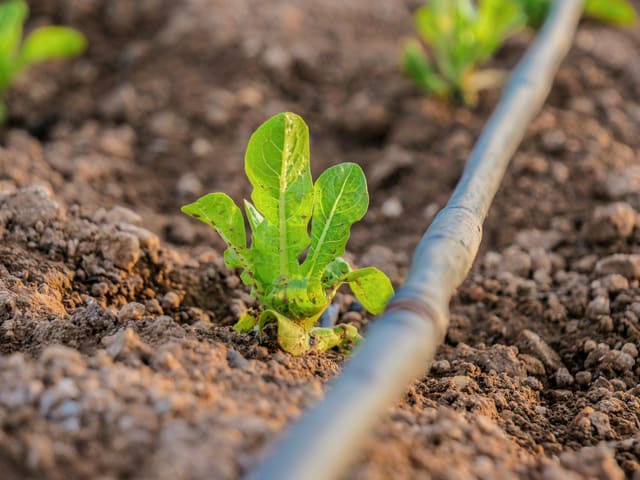
- After week 8: water when the top two inches of soil are dry, and check that emitters sit where the roots are.
Trees, rebates and what to prepare
If you're replacing a lawn under SNWA's Water Smart Landscapes program, its Tree Enhancement Program pays $100 per new qualifying tree, up to full canopy coverage, and Henderson adds $50 per tree for its customers. SNWA's conditions call for a tree of 15 gallons or larger, at least 5 feet tall with a 1 to 2 inch trunk caliper, from a species with a canopy of at least 20 feet at maturity, on drip sized for the grown tree. Henderson's page states a 6-foot minimum height.
What changes a planting job: how much caliche sits under the beds, how many trees go in, whether drip already reaches the beds, and what's coming out first. Tell us which areas get afternoon sun and where you want shade. We plant, rock and run the drip with the rest of the yard, one contractor from demo to finish, and the estimate is free.
Sources
- Choosing plants and landscape planning Southern Nevada Water Authority.
- Southern Nevada Regional Plant List Southern Nevada Water Authority, June 2026.
- How and when to water and watering tips Southern Nevada Water Authority.
- Water Smart Landscapes rebate, residential program conditions and Tree Enhancement Program conditions Southern Nevada Water Authority.
- Rebate programs City of Henderson.
- Becoming a desert gardener University of Nevada Cooperative Extension, SP-01-15.
- The rose in the desert Southwest University of Nevada, Reno Extension, FS-03-15.
- Plant annuals for color University of Nevada, Reno Extension, FS-98-94.
- Chapter 14.14 Conservation Henderson Municipal Code.
- Title 30 Unified Development Code Clark County, effective September 17, 2026.


