


 All services

Since July 1, 2026, a state law sits under every ADU ordinance in the Las Vegas Valley. Nevada's AB 396 told Clark County and the valley's three big cities what their rules for accessory dwelling units can and can't do, and Henderson rewrote its own code in August. The summary below is as of November 2026. Rules for second units have moved fast here, so confirm with your city or county before you design.
What AB 396 requires
The law, approved on June 6, 2025, applies to counties of 100,000 people or more (today Clark and Washoe) and cities of 60,000 or more (Las Vegas, Henderson, North Las Vegas, Reno and Sparks). Each has to adopt an ordinance that allows ADUs on residential property. AB 396 defines an ADU as an independent living space on the same lot as the main house, whether it is attached, detached or built inside the house.
As a condition of approving an ADU, those ordinances may not:
- ban a separate kitchen;
- require more than one extra parking space, when the house's parking and the street already cover what the unit needs;
- set side or rear setbacks stricter than the main house's;
- require work on a public street, unless the build disturbed the street or public health and safety call for it;
- stop the owner from renting the unit out as housing. An ordinance may still ban its use as transient lodging.
An ADU has to meet the residential building codes and is not held to commercial codes, including a commercial fire sprinkler requirement. The law does not authorize more than two ADUs on a property, and it lets a city or county offer easier terms, such as approving the unit with a building permit instead of a planning review. If a covered city or county had no compliant ordinance before July 1, 2026, ADUs are allowed on any parcel zoned for residential use without restriction.
Henderson
Henderson's Development Code, as amended by Ordinance 4171 and in effect since August 21, 2026, defines an ADU as a building on the same lot as the house, detached, attached or built inside it, and includes tiny houses. The use table allows ADUs, with standards, in the single-family RS districts and several other residential and mixed-use districts.
- Size: up to 25% of the main house's floor area or 1,000 square feet, whichever is greater. A tiny house is capped at 400 square feet, not counting lofts. An attached garage doesn't count toward the ADU's size.
- Setbacks: front and corner side setbacks match the house's. A detached unit 14 feet tall or less needs 5 feet at the side and rear; a taller one takes the house's setbacks.
- Separation: a detached unit sits at least 6 feet from other buildings. One built closer than 6 feet to the house has to be joined to it by a roof at least 10 feet wide, or as wide as the unit if that is less.
- Number and sale: one ADU per lot, and it can't be sold apart from the house. ADUs don't count toward density limits.
- Design: the unit has to fit the house and the street in materials, colors and mass. In a front or corner side yard it must match the house's materials, roof and color. A tiny house in the rear yard is exempt from that match but must sit on a permanent foundation.
- Parking: one space per ADU.
An existing accessory building converted to an ADU is treated as meeting the setbacks, as long as it doesn't push further into them. Permits go through the city's DSC Online portal, and Henderson suggests allowing two to four weeks for plan approval.
Unincorporated Clark County
Outside the cities, Title 30 calls an ADU "accessory living quarters": a unit for one family with living, sleeping and sanitation space that may include cooking areas, and that may be rented. It can sit in part of the house without interior access, or in a separate building on the same lot. The county allows it as an accessory use in its single-family districts.
- One per lot, and only with a single-family house.
- Not on a lot smaller than 4,000 square feet, and not in a manufactured or tiny home park.
- On a lot under 10,000 square feet, the unit can't exceed 75% of the house's habitable floor area. On a larger lot it can match the house's floor area.
- A similar roof line, complementary colors and the same building materials as the house. An RV can't serve as the unit.
- One parking space per unit.
The county's code enforcement office uses "casita" for a separate structure with no kitchen. On the building side, Clark County requires a soils report for any project with a new foundation, and its guest house permit guide notes that a detached guest house needs its own source of water. Title 30's latest amendment took effect on September 17, 2026.
Summerlin straddles the line: parts sit in the City of Las Vegas and parts, such as Summerlin South, in unincorporated Clark County. Check which one your address falls in before you read the rules.
City of Las Vegas
Las Vegas rewrote its ADU rules with Ordinance 6963 on July 1, 2026. The city defines an ADU as an independent living space with kitchen facilities, for the household, its tenants, domestic employees or guests.
- One ADU per lot, no larger than the main house's gross floor area, and subject to the zone's development standards.
- No special use permit.
- One parking space beyond the spaces the house already needs.
- No ADU in front of the house, unless it has a side entry and stays out of the front setback.
- An attached unit doesn't need an inside door to the house, and a detached unit follows the zone's accessory structure standards.
Permits, soil and the owner-builder question
The valley's building departments now review under the 2024 codes: Henderson since January 2, 2026, Las Vegas since January 5 and Clark County since January 11. Nye County still lists the 2018 codes. An ADU is permitted work from the slab up, so plan for structural drawings, utility routes and inspections.
Nevada's under-$1,000 handyman exemption doesn't cover work that needs a building permit, and the state's residential remodeling class (B-7) can't add enclosed space. You can build for your own use under the owner-builder exemption, but Nevada law presumes the work was meant for sale or lease if you sell or lease the new structure within a year of completion, and the owner-builder affidavit bars hiring an unlicensed person as your contractor. That matters for a unit you plan to rent. Whoever builds it, look them up on the Nevada State Contractors Board's license search by license number, company name or owner name.
Two site checks come before any design. Clark County keeps soils maps that flag expansive and collapsible soils, and 811 has to mark the utility lines at least two working days before anyone digs a footing. Your HOA comes before the permit: Henderson's homeowner guide says HOAs are frequently more restrictive than the city.
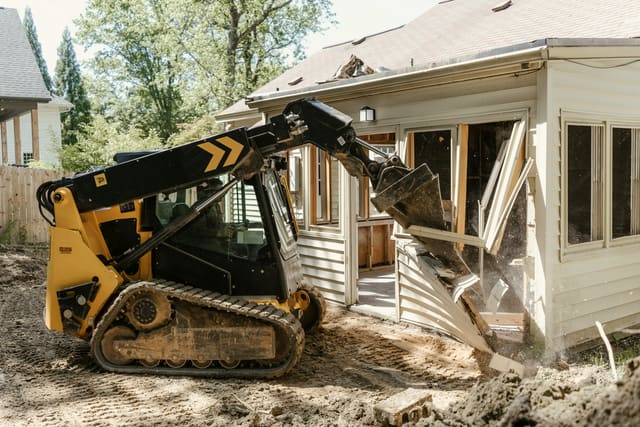
We build ADUs, and because we also do the demo, walls, pavers, irrigation and planting, the unit and the yard around it can be one job. Our ADU construction page covers how a build runs.
Before you design
- Find out whether your lot is in Henderson, Las Vegas, North Las Vegas or unincorporated Clark County.
- Note the lot size and the main house's floor area; both set the size cap.
- Mark the setbacks, easements and where water, sewer, power and gas come in.
- Ask your HOA what it requires.
- Decide how you'll use the unit. Renting it as housing is protected under AB 396; short stays may not be.
Sources
- AB 396, Statutes of Nevada 2025, Chapter 365 Nevada Legislature, approved June 6, 2025.
- Henderson Development Code 19.9.4: accessory uses, use table and parking ratios City of Henderson, effective August 21, 2026.
- Homeowner permit guide City of Henderson, January 2025.
- Which building codes does Henderson use? City of Henderson FAQ.
- Title 30: Unified Development Code Clark County, effective September 17, 2026.
- Building violations: single-family residential Clark County Code Enforcement.
- BPG-182: single family residence and guest house permit guide and soils maps policy Clark County Building Department.
- 2024 IRC Southern Nevada amendments Clark County, effective January 11, 2026.
- LVUDC 19.12.070: residential accessory dwelling unit and 19.06.040: development standards City of Las Vegas, Ordinance 6963, July 1, 2026.
- LVMC 16.02: administrative code City of Las Vegas.
- Building Department Nye County.
- NRS 624: contractors and NRS 455: excavation near subsurface installations Nevada Legislature, 2025 revision.
- Owner-builder affidavit City of Las Vegas.
- License search and handbook Nevada State Contractors Board.
Rules change. Check the current requirements for your property before you build; nothing here is legal advice.


