
 All services

A patio, walk or driveway here comes down to two choices: interlocking concrete pavers on a sand-and-gravel base, or a poured concrete slab. Both are concrete. They behave differently in a place where July averages 104.5°F at Harry Reid International Airport and the ground can be clay or caliche. The points below come from what the industry bodies and local agencies publish.
What sits under each one
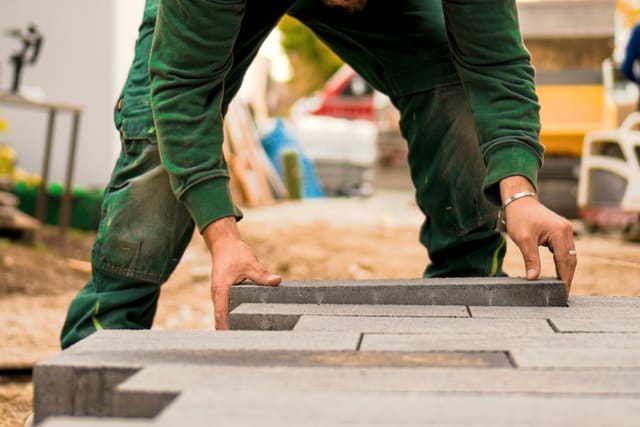
A paver surface is flexible. The Concrete Masonry & Hardscapes Association (CMHA), which now publishes the old ICPI guidance, describes the build: compacted soil, a crushed aggregate base, about an inch of bedding sand, then the pavers with sand swept into the joints. For patios and walks CMHA calls for at least 4 inches of compacted base over well-drained soil, and at least 6 inches for a residential driveway, compacted to 98% of standard Proctor density. The pavers for patios and driveways are 60 mm (2 3/8 in.) thick. Pavers made to ASTM C936 have to average at least 8,000 psi in compressive strength.
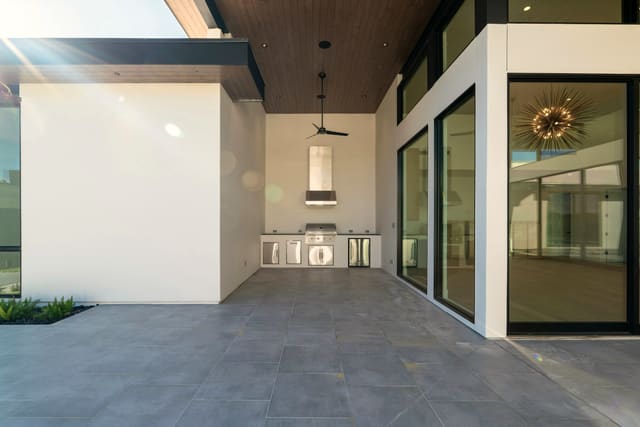
A poured slab is rigid: one piece of concrete, cut into panels by control joints. The National Ready Mixed Concrete Association (NRMCA) calls joints "pre-planned cracks." It spaces them 24 to 36 times the slab's thickness, which is about 10 feet on a 4-inch slab, with 15 feet as the most, and keeps each panel close to square, no longer than 1.5 times its width. The saw cuts go a quarter of the slab's depth, within 4 to 12 hours of finishing.
Pouring concrete in desert heat
Heat is where the two part ways on install day. ACI 305R-20, the American Concrete Institute's hot-weather guide, lists faster setting and a greater tendency for plastic shrinkage and thermal cracking among the problems of fresh concrete in hot weather. NRMCA adds that the conditions behind it, high wind, low humidity and strong sun, can come at any time of year in arid climates, and that a hot day followed by a cool night can cause thermal cracking.
Plastic shrinkage cracks form when the surface dries faster than bleed water can rise to replace it, and NRMCA names wind over 5 mph as one trigger. ACI and NRMCA list the countermeasures: schedule the pour for a cooler time of day or night, dampen the subgrade and forms first, put up windbreaks or fog the air above the slab, start curing as soon as finishing ends and keep it going for at least 3 days. NRMCA notes that a white curing compound helps reflect heat from the surface.
Pavers skip that step. They arrive from the plant already cured, so the site work is grading, compacting and laying. CMHA's note on utility repairs points out that relaid pavers need no curing on site and can take traffic right away.
Cracks, settling and repairs
Control joints exist to decide where a slab cracks as it shrinks. A crack that wanders outside the joints can only be patched or cut out.
CMHA's argument for pavers comes from streets and utility trenches, and it makes sense to read it that way. It says the joints between pavers let them take minor settling in the base or soil without cracking, while any break in a single-piece pavement, joint, cut or crack, shortens its life. When a line underneath needs work, pavers lift out without a saw or jackhammer and go back in the same pattern. CMHA also cites a 2023 life-cycle study that found lower maintenance costs for interlocking pavements than for asphalt or poured concrete, though CMHA presents it for streets and utility cuts.
Pavers have their own failure: they can sink. CMHA calls a small amount of settling normal for any flexible pavement and limits lippage between pavers to 1/8 inch on walkways. CMHA ties settlement to compaction of the soil and base, and says bedding sand must never be used to level an uneven base.
Clay, caliche and the base
The Southern Nevada Water Authority describes most Las Vegas Valley soil as clay, sand and rock-hard caliche. Clark County keeps a soils map and a separate expansive soils map; the soils map's legend flags clay swell, gypsum and collapsible ground. CMHA notes that builders use thicker bases where soils are expansive.
Both surfaces depend on the ground under them. A paver base can be dug out and rebuilt in one spot if it settles, and the same pavers go back on top. A slab that heaves or drops has to be cut out and poured again. Either way, the dig is the time to find caliche or soft clay and deal with it.
Wind, sand and upkeep
Wind pulls sand out of paver joints. CMHA calls joint stabilizers optional for most paving but says they have held joint sand well in desert climates with high winds, and that dry stabilizers, polymeric joint sands included, suit homes. They add no strength. For upkeep, CMHA's maintenance guide says to top up joint sand once it drops more than half an inch, using dry sand and not polymeric sand.
New pavers can show a white haze. CMHA identifies it as efflorescence, harmless to the units, and says it can peak about 60 days after installation.
Water rules and permits
As of November 2026, Henderson needs no building permit for walks and driveways no more than 30 inches above grade, and its Development Code lets an uncovered patio up to 1 foot above grade run to the property line. For new homes in unincorporated Clark County, Title 30 caps hardscape at 60% of the front and side yards. Whichever surface you choose, the dig needs an 811 call at least 2 working days ahead under Nevada law.
Choosing for your yard
- Pavers suit patios, walks and driveways where you want repairs to be simple, where irrigation or utility lines run underneath, or where the area is part of an SNWA grass conversion.
- Poured concrete suits a plain slab where you accept control joints and plan the pour around the heat: early hours, windbreaks, curing for at least 3 days.
- Either one needs a compacted base and a look at the soil before anything goes on top.
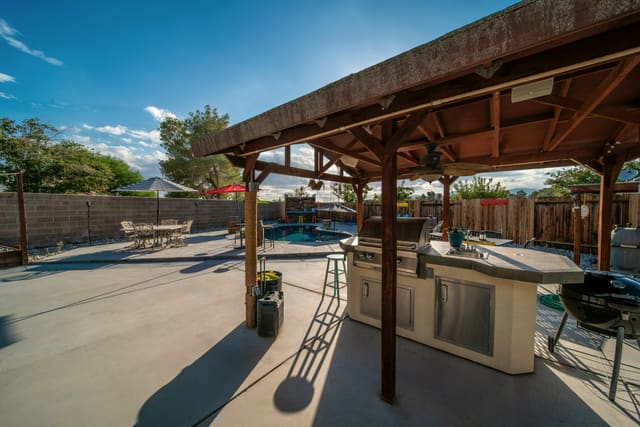
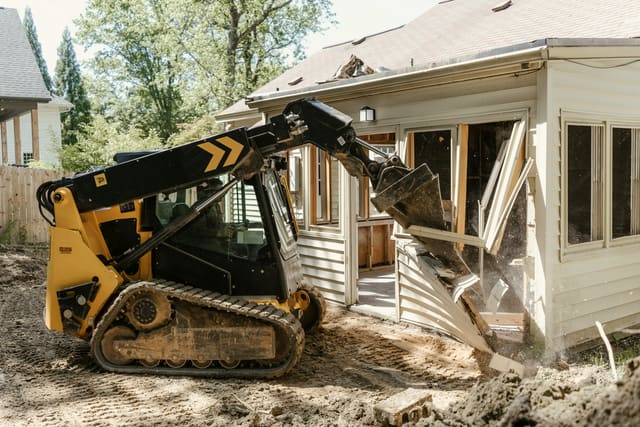
We build paver patios, walks and driveways and do the demolition of the old surface, so one contractor handles the job from tear-out to the last joint. The pavers page has more on how we build a paver base, and the patios page covers patio covers and shade. The estimate is free.
Sources
- PAV-TEC-002: Construction of interlocking concrete pavements Concrete Masonry & Hardscapes Association, revised 2022.
- PAV-TEC-005: Cleaning, sealing and joint sand stabilization Concrete Masonry & Hardscapes Association, revised 2022.
- PAV-TEC-006: Operation and maintenance guide for interlocking concrete pavement Concrete Masonry & Hardscapes Association.
- PAV-TEC-007: Repair of utility cuts using interlocking concrete pavements Concrete Masonry & Hardscapes Association, revised 2023.
- ACI 305R-20: Guide to hot weather concreting (preview) American Concrete Institute, 2020.
- CIP 5: Plastic shrinkage cracking, CIP 6: Joints in concrete slabs on grade and CIP 12: Hot weather concreting National Ready Mixed Concrete Association.
- Temperature overview, Las Vegas National Weather Service Las Vegas, 1991–2020 normals.
- Choosing plants Southern Nevada Water Authority.
- Clark County soils maps (BD-PP-228) Clark County Building Department, revised July 2026.
- Soils guideline map layers Clark County GIS.
- Water Smart Landscapes rebate: residential program conditions and rebate FAQ Southern Nevada Water Authority.
- HMC 15.01.130: Building permit exemptions City of Henderson Municipal Code.
- HDC 19.10.5: Setbacks, features allowed within setbacks Henderson Development Code, effective December 20, 2024.
- Title 30 Unified Development Code, 30.04.01 Clark County, amended through September 2026.
- NRS 455: Excavation and demolition near subsurface installations Nevada Legislature.
Rules change. Check the current requirements for your property before you build; nothing here is legal advice.


