 All services

Artificial turf solves a real problem in the valley: Henderson, North Las Vegas and the Las Vegas Valley Water District all restrict new grass, and turf gives you a green surface without the water. The trade-off is heat. Researchers have measured it in Las Vegas and in Pennsylvania, and the numbers explain why we plan a turf yard around shade before we plan it around looks.
How hot the valley gets
The National Weather Service keeps the official record for Las Vegas at Harry Reid International Airport. Its 1991 to 2020 normals put the average July high at 104.5°F and the average July low at 82.0°F. A normal year has 78.2 days at or above 100°F and 9.4 days at or above 110°F, and on July 7, 2024 the airport set its all-time record of 120°F.
Nights don't give much back either. The NWS notes that the airport often runs 5 to 15 degrees warmer at night than outlying parts of the valley, an urban heat island effect.
What the Las Vegas study measured
Researchers from UNLV and the Desert Research Institute compared green artificial turf with irrigated natural grass at a Las Vegas city park and at the UNLV greenhouse complex, from August 2006 to March 2007. At its hottest, the artificial turf surface ran about 69°F above the irrigated grass and 62°F above the air. The highest reading was 169°F.
The researchers traced the heat to solar radiation more than to air temperature, which matters for anyone planning a yard: the sun on the surface drives the number, so shade is what you can change. They tested one product, and they suggested that buyers look at more reflective colors to keep surface temperatures down.
Does watering cool it down?
For a short while. Penn State's Center for Sports Surface Research has tested this more than once.
- Watering at midday (2015). On a sunny, breezy June day in central Pennsylvania, the hottest natural grass reading was 95.4°F and the hottest synthetic turf reading was 155.7°F. Watering dropped the turf below 100°F, but it climbed back above 120°F within 45 minutes after a light watering and within an hour and 15 minutes after a heavy one of three-quarters of an inch. Ninety minutes after watering, every treatment read over 130°F. The researchers concluded that turf temperatures rebound fast while the sun is at its strongest.
- Earlier work. Penn State cites reports of infill turf reaching 93°C, about 199°F, on a day when the air was 37°C, about 99°F. In another study it cites, 30 minutes of watering brought turf down to the temperature of nearby grass, 29°C (about 84°F), and within five minutes it was back at 49°C (about 120°F). Penn State's own tests found that watering before dawn did little for the surface by afternoon.
Penn State also notes that a clear day around 80°F can heat turf more than a hazy, humid day with higher air temperatures, and the NWS describes Las Vegas as a place of abundant sunshine all year. Watering turf to cool it also uses the water you put turf in to save.
Infill, fiber and color
Turf products differ, though by less than the marketing suggests. A 2024 review in the International Journal of Biometeorology pulled together 23 studies comparing synthetic and natural grass. Surface and air temperature were the only measures that ran consistently higher over synthetic: the surface by 9.4 to 33.7°C (about 17 to 61°F), the air by 0.5 to 1.2°C.
The review found that styrene butadiene rubber infill (crumb rubber) and shock pads raised surface temperatures, while thermoplastic elastomer infill and some cooling fiber and infill products lowered them. It also found that the combined heat-stress measures used for athletes, such as wet-bulb globe temperature, came out about the same over both surfaces.
Penn State's 2012 lab and outdoor tests are a useful check on the marketing. The report said no scientific reports backed the lower-temperature claims made for alternative infills, and when its researchers tested fibers and infills as complete turf systems, none produced a substantial drop in surface temperature compared with standard green fiber over black rubber. An earlier UNLV trial that painted black rubber infill white lowered the surface by only a few degrees. We'll show you the infill options, and we plan for shade either way.
Planning a turf yard you can use in summer
Since the sun drives the heat, shade and layout are where you gain the most. On the jobs we plan, that means:
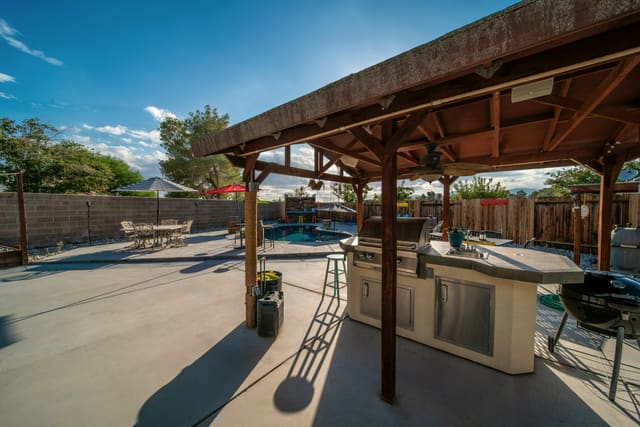
- Turf where the afternoon shade falls. A patio cover over or beside the turf, or trees on its west side, keeps the sun off during the hottest hours. SNWA says shade keeps areas 10 to 25 degrees cooler. Our patio and patio cover page covers the build.
- Trees that belong here. Blue palo verde, foothill palo verde, desert willow and several mesquites are on the region's plant list and on SNWA's list of trees that qualify for its tree rebate during a lawn conversion. See our planting page.
- Less turf, more planting. A smaller turf panel set among planted beds and rock heats a smaller area. If you're replacing a real lawn and want SNWA's rebate, half the converted area has to be living plant cover at maturity anyway.
- The right hours. Morning and evening are when turf works for kids and dogs in summer. Touch the surface with the back of your hand before anyone goes out barefoot.
- Color. The UNLV researchers suggested more reflective colors. Ask to see samples out in the sun.
What the rules say about turf
Nevada's HOA law, NRS 116.330, bars an association from prohibiting drought-tolerant landscaping in a yard the owner uses, and it names decorative rock and artificial turf in its definition. The HOA can still ask for plans, review them for architectural style and request changes, but it can't unreasonably refuse approval.
SNWA's Water Smart Landscapes rebate accepts permeable artificial turf in place of rock or bark in a converted lawn area, provided the area still reaches 50 percent living plant cover at maturity on drip irrigation. Our post on the SNWA grass removal rebate has every condition as of November 2026.
We lay turf with the stepping stones, beds, drip and patio cover around it, one contractor from demo to finish, so the shade gets planned with the turf instead of after it. Estimates are free; see our artificial grass page for how a job goes.
Sources
- Climate of Las Vegas National Weather Service Las Vegas.
- Temperature overview and number of days with a specific temperature National Weather Service Las Vegas, updated April 2026.
- Highest and lowest maximum temperatures ever recorded National Weather Service Las Vegas.
- Study finds artificial turf may be too hot for summer use UNLV, September 18, 2008.
- The effect of irrigation on synthetic turf characteristics Penn State Center for Sports Surface Research, 2015.
- Temperature amelioration of synthetic turf surfaces through irrigation Penn State Center for Sports Surface Research.
- Synthetic turf heat evaluation: progress report Penn State Center for Sports Surface Research, January 2012.
- The effect of synthetic grass sports surfaces on the thermal environment: a systematic review International Journal of Biometeorology 68, 2024.
- Water Smart Landscapes rebate and residential program conditions Southern Nevada Water Authority.
- List of qualifying trees and Southern Nevada Regional Plant List Southern Nevada Water Authority.
- NRS 116.330: drought tolerant landscaping Nevada Legislature (2025 revision).
Rules change. Check the current requirements for your property before you build; nothing here is legal advice.


